Catatan kecil buku “Membongkar Mitos Kesusastraan Indonesia”
Taufiq Wr. Hidayat *
the spaces of world figures, literature studies, new school of thought in the world of literature (art, letters, etc.)
Tampilkan postingan dengan label Sutardji Calzoum Bachri. Tampilkan semua postingan
Selasa, 17 September 2019
Rabu, 04 April 2018
Membaca Buku Kritik Sastra "Membongkar Mitos Kesusastraan Indonesia"
: Membaca Subyektivitas (Nurel) atas Subyektivitas (Ignas Kleden dan Sutardji Calzoum Bachri)
Sabtu, 03 Maret 2018
Bedah buku di PDS H.B. Jassin "Membongkar Mitos Kesusastraan Indonesia"
Bedah buku Membongkar
Mitos Kesusastraan Indonesia akan diadakan di PDS HB Jassin pada April depan
dengan pembahas Sihar Ramses Simatupang dan moderator Bp. Eka Chris Eka
Budianta, lalu pemantik diskusinya Sunu Wasono bersama Sofyan RH.
Zaid. Mari ramaikan dan jangan ketinggalan
untuk order bukunya. LIMITED STOKS.
Rabu, 26 Oktober 2011
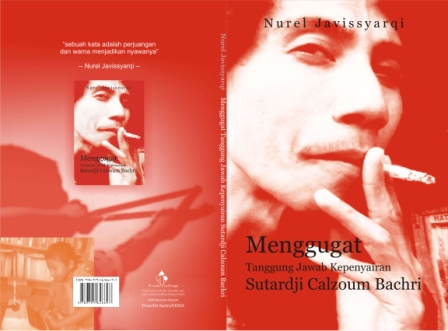
Sue Responsibility of Authorship of Sutardji Calzoum Bachri
Epilogue
Written by Nurel Javissyarqi
Translated by Agus B. Harianto
Two essays of Tardji as an attachment is sufficiently to identify his anatomy in the field of literature that deals with “the mantra” from its roots, which is the tradition.
Written by Nurel Javissyarqi
Translated by Agus B. Harianto
Two essays of Tardji as an attachment is sufficiently to identify his anatomy in the field of literature that deals with “the mantra” from its roots, which is the tradition.
Sue Responsibility of Authorship of Sutardji Calzoum Bachri (VII)
Written by Nurel Javissyarqi
Translated by Agus B. Harianto
VII
This section I followed an odd number VII, the final space of my disagreement with Tardji. Which was begun by his delirium that the Lord imagined, dreamed, had inspired me to visit:
Translated by Agus B. Harianto
VII
This section I followed an odd number VII, the final space of my disagreement with Tardji. Which was begun by his delirium that the Lord imagined, dreamed, had inspired me to visit:
Sabtu, 08 Oktober 2011
Sue Responsibility of Authorship of Sutardji Calzoum Bachri (VI)
Written by Nurel Javissyarqi
Translated by Agus B. Harianto
http://pustakapujangga.com/2011/10/sue-responsibility-of-authorship-of-sutardji-calzoum-bachri-vi/
VI
In the book Raja Mantra Presiden Penyair, the poet, Taufik Ikram Jamil, wrote an essay entitle Bersama Sutardji Calzoum Bachri which has 16 pages, from page 64 to 79, tells of his familiarity with the figure which is known as mantra maker. Ikram told the story of Tardji since he was a kid to the creative process on the land of Pasundan, with warm hug of longing, it seems that Ikram knows exactly tread step and sniffed the scent, sign and shape of any cloud shades.
Translated by Agus B. Harianto
http://pustakapujangga.com/2011/10/sue-responsibility-of-authorship-of-sutardji-calzoum-bachri-vi/
VI
In the book Raja Mantra Presiden Penyair, the poet, Taufik Ikram Jamil, wrote an essay entitle Bersama Sutardji Calzoum Bachri which has 16 pages, from page 64 to 79, tells of his familiarity with the figure which is known as mantra maker. Ikram told the story of Tardji since he was a kid to the creative process on the land of Pasundan, with warm hug of longing, it seems that Ikram knows exactly tread step and sniffed the scent, sign and shape of any cloud shades.
Nurel Javissyarqi Sued Sutardji *)
Written by Chamim Kohari **)
Translated by Agus B. Harianto
http://pustakapujangga.com/2011/10/nurel-javissyarqi-sued-sutardji/
”Penyair-penyair itu diikuti oleh orang-orang yang dungu.
Tidakkah kau lihat mereka menenggelamkan diri dalam sembarang lembah hayalan dan kata,
dan mereka suka mengujarkan apa yang tak mereka kerjakan kecuali mereka yang beriman,
beramal baik, banyak mengingat dan menyebut Allah dan melakukan pembelaan ketika dizalimi”.
(Terjemahan QS. Asysyu’araa: 224-227)
Translated by Agus B. Harianto
http://pustakapujangga.com/2011/10/nurel-javissyarqi-sued-sutardji/
”Penyair-penyair itu diikuti oleh orang-orang yang dungu.
Tidakkah kau lihat mereka menenggelamkan diri dalam sembarang lembah hayalan dan kata,
dan mereka suka mengujarkan apa yang tak mereka kerjakan kecuali mereka yang beriman,
beramal baik, banyak mengingat dan menyebut Allah dan melakukan pembelaan ketika dizalimi”.
(Terjemahan QS. Asysyu’araa: 224-227)
Sabtu, 01 Oktober 2011
The Truth of Language, Mantra, and Responsibility
(The Response to Book Entitle “Menggugat Tanggung Jawab Kepenyairan Sutardji Calzoum Bachri (Sue Responsibility of Authorship of Sutardji Calzoum Bachri)”
By Mahmud Ali Jauhari
Translated by Agus B. Harianto
What is in your mind when you read the title above? Is it pattern of language? Shaman who is reciting a mantra? A man who was fulfilling his responsibilities? Or, what?
That day, in a study room, I listened to a short question, “What is language?” Perhaps you’ve heard it either. Or, maybe not. Regarding to the question, many people answer it with a simple sentence, “Language is a communication tool.” The question now, is it true that language is a communication tool?
By Mahmud Ali Jauhari
Translated by Agus B. Harianto
What is in your mind when you read the title above? Is it pattern of language? Shaman who is reciting a mantra? A man who was fulfilling his responsibilities? Or, what?
That day, in a study room, I listened to a short question, “What is language?” Perhaps you’ve heard it either. Or, maybe not. Regarding to the question, many people answer it with a simple sentence, “Language is a communication tool.” The question now, is it true that language is a communication tool?
Jumat, 23 September 2011
Sue Responsibility of Authorship of Sutardji Calzoum Bachri (V)
Written by Nurel Javissyarqi
Translated by Agus B. Harianto
V
There are several Java’s mantra adopted from the doctrine values of Islam, if one of which is far from it should be, it will contaminate spiritual of its depths, such as the spell kulhu sunsang, taken from surah Al-Ikhlas, but distorted till turned a summersault aimlessly.
The mantras which have low-power spiritual and its aura seen red, are easy to learn because it serves to jinn or be united in one with jinn; the patterns of deviation from the true teaching that is deliberately dismantled for the sake of particular fame. It is usually worn by shamans who are not responsible.
Translated by Agus B. Harianto
V
There are several Java’s mantra adopted from the doctrine values of Islam, if one of which is far from it should be, it will contaminate spiritual of its depths, such as the spell kulhu sunsang, taken from surah Al-Ikhlas, but distorted till turned a summersault aimlessly.
The mantras which have low-power spiritual and its aura seen red, are easy to learn because it serves to jinn or be united in one with jinn; the patterns of deviation from the true teaching that is deliberately dismantled for the sake of particular fame. It is usually worn by shamans who are not responsible.
Rabu, 21 September 2011
Reviewing the Authorship of Sutardji Calzoum Bachri (SCB) from Nurel’s Book: “MENGGUGAT TANGGUNGJAWAB KEPENYAIRAN”
(Sue Responsibility of Authorship of Sutardji Calzoum Bachri)*
Written by Aguk Irawan MN**
Translated by Agus B. Harianto
Penyair-penyair itu diikuti orang-orang yang sesat. Tidakkah kau lihat mereka menenggelamkan diri dalam sembarang lembah khayalan dan kata. Dan mereka sering mengujarkan apa yang tak mereka kerjakan. Kecuali mereka yang beriman, beramal baik, banyak mengingat dan menyebut Allah dan melakukan pembelaan ketika didzalimi. (QS As-Syu’ara, 224-227)
Written by Aguk Irawan MN**
Translated by Agus B. Harianto
Penyair-penyair itu diikuti orang-orang yang sesat. Tidakkah kau lihat mereka menenggelamkan diri dalam sembarang lembah khayalan dan kata. Dan mereka sering mengujarkan apa yang tak mereka kerjakan. Kecuali mereka yang beriman, beramal baik, banyak mengingat dan menyebut Allah dan melakukan pembelaan ketika didzalimi. (QS As-Syu’ara, 224-227)
Jumat, 16 September 2011
Sue Responsibility of Authorship of Sutardji Calzoum Bachri (IV)
Written by Nurel Javissyarqi
Translated by Agus B. Harianto
“Buku ini ditulis (keterangan sebelumnya; ada membicarakan sifat-sifat manusia Indonesia, dalam cara seperti dikemukakan oleh Saudara Mochtar Lubis. Dicetak tahun 1920, Haarlem, pengarangnya Prof. J.C. van Eerde, guru besar Universitas Amsterdam dan Direktur dari Koloniaal Institute te Amsterdam. Judulnya: Inleiding tot de Volkenkude van Nederlandsch Indie) dalam tahun 1920, dan dalam tahun-tahun 20-an itu timbul Renaissance Indonesia dengan gerakan Pemuda Indonesia, dan lahirnya Sumpah Pemuda, dan perangsang lagu kebangsaan Indonesia Raya.
Translated by Agus B. Harianto
IV
From quotation of Dr. Abu Hanifah’s writing, Menyambut Ceramah Mochtar Lubis, Renungan Tentang “Manusia Indonesia Masa Kini” at part Lahirlah Sumpah Pemuda:“Buku ini ditulis (keterangan sebelumnya; ada membicarakan sifat-sifat manusia Indonesia, dalam cara seperti dikemukakan oleh Saudara Mochtar Lubis. Dicetak tahun 1920, Haarlem, pengarangnya Prof. J.C. van Eerde, guru besar Universitas Amsterdam dan Direktur dari Koloniaal Institute te Amsterdam. Judulnya: Inleiding tot de Volkenkude van Nederlandsch Indie) dalam tahun 1920, dan dalam tahun-tahun 20-an itu timbul Renaissance Indonesia dengan gerakan Pemuda Indonesia, dan lahirnya Sumpah Pemuda, dan perangsang lagu kebangsaan Indonesia Raya.
Minggu, 11 September 2011
Sue Responsibility of Authorship of Sutardji Calzoum Bachri (III)
Written by Nurel Javissyarqi
Translated by Agus B. Harianto
III
The name of Sutardji Calzoum Bachri is familiar in Indonesian literature for his Poetry Credo. Below I quote some part of it:
“Kata-kata harus bebas dari penjajahan pengertian, dari beban idea. Kata-kata harus bebas menentukan dirinya sendiri.
“The words must be free from colonialism of understanding, from the burden of ideas. The words should be free to decide themselves.”
Translated by Agus B. Harianto
III
The name of Sutardji Calzoum Bachri is familiar in Indonesian literature for his Poetry Credo. Below I quote some part of it:
“Kata-kata harus bebas dari penjajahan pengertian, dari beban idea. Kata-kata harus bebas menentukan dirinya sendiri.
“The words must be free from colonialism of understanding, from the burden of ideas. The words should be free to decide themselves.”
Minggu, 28 Agustus 2011
Sue Responsibility of Authorship of Sutardji Calzoum Bachri (II)
Written by Nurel Javissyarqi
Translated by Agus B. Harianto
II
Before I wrote a little further, allowed me to confide about what I felt for this moment. Actually I’m not old enough and science to interpret it. But to answer the Tardji’s essay and the interpreting of the poets I’ve ever read about Asy Syu’ara, I felt like there was a wind blow forced me to write on. Certainly, it will not hamper re-determination in the future, for the sake of sharpening the meaning of life experiences, so sure of, and that’s the prologue of the wanderer.Selasa, 23 Agustus 2011
Sue Responsibility of Authorship of Sutardji Calzoum Bachri (I)
Written by Nurel Javissyarqi
Translated by Agus B. Harianto
I
This paper is a response to the essay of Sutardji Calzoum Bachri entitled Sajak dan Pertanggungjawaban Penyair; his cultural oration at the Pekan Presiden Penyair, published by Republika, September, 9, 2007. In the writing, Tardji stated that text of Sumpah Pemuda is poetry, which is based on the schools of Ibn Arabi, kun fayakun, then he developed the following phrases:
Kamis, 18 Agustus 2011
Sue Responsibility of Authorship of Sutardji Calzoum Bachri
Written by Nurel Javissyarqi
Translated by Agus B. Harianto
Acknowledgement (historical story)
As usual, I search the data from the mass media on Google for myself to be uploaded onto the website http://sastra-indonesia.com/ on which has been running since July 2008. I was ready to take serious risk to make the site from transportation fee of the literary event in Jakarta. After from the capital city, I felt as if I had become a poet, moreover I read a poem on same stage with the masters of literature, on the eve of the inaugural of Guru Besar (Professor) Abdul Hadi W.M., on the campus of Paramadina.
Translated by Agus B. Harianto
Acknowledgement (historical story)
As usual, I search the data from the mass media on Google for myself to be uploaded onto the website http://sastra-indonesia.com/ on which has been running since July 2008. I was ready to take serious risk to make the site from transportation fee of the literary event in Jakarta. After from the capital city, I felt as if I had become a poet, moreover I read a poem on same stage with the masters of literature, on the eve of the inaugural of Guru Besar (Professor) Abdul Hadi W.M., on the campus of Paramadina.
Langganan:
Postingan (Atom)
A. Syauqi Sumbawi
A.C. Andre Tanama
Aang Fatihul Islam
Abdul Aziz Rasjid
Abdul Hadi W. M.
Adam Roberts
Adelbert von Chamisso
Adreas Anggit W.
Aguk Irawan MN
Agus B. Harianto
Agus R. Sarjono
Ahmad Farid Yahya
Ahmad Yulden Erwin
Akhmad Sahal
Akhmad Sekhu
Albert Camus
Albrecht Goes
Alexander Pushkin
Alit S. Rini
Amien Kamil
Amy Lowell
Andra Nur Oktaviani
André Chénier
Andy Warhol
Angela
Angela Dewi
Angrok
Anindita S. Thayf
Anton Bruckner
Anton Kurnia
Anwar Holid
Arif Saifudin Yudistira
Arthur Rimbaud
Arti Bumi Intaran
AS Laksana
Asep Sambodja
Awalludin GD Mualif
Axel Grube
Bambang Kariyawan Ys
Basoeki Abdullah
Beethoven
Ben Okri
Bernando J. Sujibto
Berthold Damshäuser
Berto Tukan
BI Purwantari
Birgit Lattenkamp
Blaise Cendrars
Book Cover
Brunel University London
Budi Darma
Buku Kritik Sastra
C.C. Berg
Candra Kurnia
Cecep Syamsul Hari
Chairil Anwar
Chamim Kohari
Charles Baudelaire
Claude Debussy
Cristina Lambert
D. Zawawi Imron
Damhuri Muhammad
Dana Gioia
Daniel Paranamesa
Dante Alighieri
Dante Gabriel Rossetti (1828-1882)
Dareen Tatour
Darju Prasetya
Darwin
Dea Anugrah
Denny Mizhar
Diponegoro
Djoko Pitono
Djoko Saryono
Dwi Cipta
Dwi Kartika Rahayu
Dwi Pranoto
Edgar Allan Poe
Eka Budianta
Eka Kurniawan
Emha Ainun Nadjib
Emily Dickinson
Enda Menzies
Endorsement
Ernest Hemingway
Erwin Setia
Essay
Evan Ys
Fahmi Faqih
Fatah Anshori
Fazabinal Alim
Feby Indirani
François Villon
François-Marie Arouet (Voltaire)
Frankfurt Book Fair 2015
Franz Kafka
Franz Schubert
Franz Wisner
Frederick Delius
Friedrich Nietzsche
Friedrich Schiller
Fritz Senn
FX Rudy Gunawan
G. J. Resink
Gabriel García Márquez
Gabriela Mistral
Gerson Poyk
Goenawan Mohamad
Goethe
Hamid Dabashi
Hardi Hamzah
Hasan Junus
Hazrat Inayat Khan
Henri de Régnier
Henry Lawson
Hera Khaerani
Hermann Hesse
Ibnu Rusydi
Ibnu Wahyudi
Ignas Kleden
Igor Stravinsky
Imam Nawawi
Indra Tjahyadi
Inspiring Writer
Interview
Iskandar Noe
Jakob Sumardjo
Jalaluddin Rumi
James Joyce
Jean-Paul Sartre
Jiero Cafe
Johann Sebastian Bach
Johannes Brahms
John H. McGlynn
John Keats
José de Espronceda
Jostein Gaarder
Kamran Dikarma
Katrin Bandel
Khalil Gibran (1883-1931)
Koesoema Affandi
Koh Young Hun
Komunitas Deo Gratias
Komunitas Penulis Katolik Deo Gratias
Koskow
Kulya in the Niche of Philosophjy
Laksmi Pamuntjak
Laksmi Shitaresmi
Lathifa Akmaliyah
Laurencius Simanjuntak
Leila S Chudori
Leo Tolstoy
Lontar Foundation
Lorca
Lord Byron
Ludwig Tieck
Luís Vaz de Camões
Lutfi Mardiansyah
Luthfi Assyaukanie
M. Yoesoef
M.S. Arifin
Mahmoud Darwish
Mahmud Ali Jauhari
Mahmudi
Maman S. Mahayana
Marco Polo
Martin Aleida
Mathori A Elwa
Max Dauthendey
Membongkar Mitos Kesusastraan Indonesia
Michael Kumpfmüller
Michelangelo
Milan Djordjevic
Minamoto Yorimasa
Modest Petrovich Mussorgsky
Mozart
Mpu Gandring
Muhammad Iqbal
Muhammad Muhibbuddin
Muhammad Yasir
Mulla Shadra
Nenden Lilis A
Nikmah Sarjono
Nikolai Andreyevich Rimsky-Korsakov
Nirwan Ahmad Arsuka
Nirwan Dewanto
Nizar Qabbani
Noor H. Dee
Notes
Novel Pekik
Nunung Deni Puspitasari
Nurel Javissyarqi
Octavio Paz
Orasi Budaya
Orhan Pamuk
Pablo Neruda
Panos Ioannides
Patricia Pawestri
Paul Valéry
Paul van Ostaijen
PDS H.B. Jassin
Penerbit SastraSewu
Percy Bysshe Shelley
Pierre de Ronsard
Poems
Poetry
Pramoedya Ananta Toer
Pustaka Ilalang
PUstaka puJAngga
Putu Setia
Pyotr Ilyich Tchaikovsky
R. Ng. Ronggowarsito (1802-1873)
Rabindranath Tagore
Radhar Panca Dahana
Rainer Maria Rilke
Rakai Lukman
Rama Dira J
Rambuana
Read Ravel
Rengga AP
Resensi
reviewer
RF. Dhonna
Richard Strauss
Richard Wagner
Ridha al Qadri
Robert Desnos
Robert Marcuse
Ronny Agustinus
Rosalía de Castro
Ruth Martin
S. Gunawan
Sabine Müller
Samsul Anam
Santa Teresa
Sapardi Djoko Damono
Sara Teasdale
Sasti Gotama
Saut Situmorang
Schreibinsel
Self Portrait Nurel Javissyarqi by Wawan Pinhole
Seno Joko Suyono
Sergi Sutanto
Shiny.ane el’poesya
Sholihul Huda
Short Story
Sigit Susanto
Sihar Ramses Simatupang
Siwi Dwi Saputro
Soeprijadi Tomodihardjo
Sofyan RH. Zaid
Solo Exhibition Rengga AP
Sony Prasetyotomo
Sri Wintala Achmad
Stefan Zweig
Stefanus P. Elu
Subagio Sastrowardoyo
Sunlie Thomas Alexander
Sunu Wasono
Suryanto Sastroatmodjo
Sutardji Calzoum Bachri
Sutejo
Syahruddin El-Fikri
T.S. Eliot
Taufik Ikram Jamil
Taufiq Ismail
Taufiq Wr. Hidayat
Tengsoe Tjahjono
Thales
The World Readers Award
Tito Sianipar
Tiya Hapitiawati
To Take Delight
Toeti Heraty
Tunggul Ametung
Ulysses
Umar Junus
Unknown Poet From Yugoslavia
Usman Arrumy
Utami Widowati
Vladimir Nabokov
W.S. Rendra
Walter Savage Landor (1775-1864)
Watercolour Paint
Wawan Eko Yulianto
Wawan Pinhole
Welly Kuswanto
Wildani Hefni
William Blake
William Butler Yeats
Wizna Hidayati Umam
World Letters
X.J. Kennedy
Yasraf Amir Piliang
Yasunari Kawabata
Yogas Ardiansyah
Yona Primadesi
Yuja Wang
Yukio Mishima
Z. Afif
Zadie Smith
Zeynita Gibbons