Tampilkan postingan dengan label Yukio Mishima. Tampilkan semua postingan
Tampilkan postingan dengan label Yukio Mishima. Tampilkan semua postingan
Jumat, 16 Maret 2018

Selasa, 13 Maret 2012
Artículo publicado en el diario Sankei el 7 de julio de 1970
Yukio Mishima
Cuando pienso en mis últimos veinticinco años me maravillo de cuán vacíos han sido. No puedo decir que realmente he “vivido”. Sólo los atravesé tapándome la nariz.
Aquello que odiaba hace veinticinco años continúa sobreviviendo con obstinación, si bien bajo formas levemente distintas. No sólo sobrevivió sino que se propagó y se infi ltró con enorme virulencia en todo Japón. Se trata del terrible virus de la democracia de posguerra y de la hipocresía que generó.
Cuando pienso en mis últimos veinticinco años me maravillo de cuán vacíos han sido. No puedo decir que realmente he “vivido”. Sólo los atravesé tapándome la nariz.
Aquello que odiaba hace veinticinco años continúa sobreviviendo con obstinación, si bien bajo formas levemente distintas. No sólo sobrevivió sino que se propagó y se infi ltró con enorme virulencia en todo Japón. Se trata del terrible virus de la democracia de posguerra y de la hipocresía que generó.
Rabu, 24 Maret 2010
Yukio Mishima (1925-1970)
http://pustakapujangga.com/2010/02/yukio-mishima-1925-1970/
Written by Nurel Javissyarqi
Translated by Agus B. Harianto
Before get far entering the veil of fate of Yukio Mishima, allow me, at first to summarize his life story from the book Sang Samurai compiled by Agata P. Ranjabar, published by Penerbit Pinus, July 2009.
Yukio Mishima (1925-1970) born in the Yotsuya, Shinjuku. His father was Azusa Hiraoka, his mother Shizue. His childhood was shadowed by his grandmother Natsu, the nurse, as well as separator from his family. Natsu was the illegitimate daughter of Yoritaka Matsudaira, Daimyo Shishido in Hitachi province that grows in Prince Arisugawa Taruhito family. Mishima was back to his family at 12 years old, wrote some story and he also pleased Oscar Wilde’s, Rilke and the classical Japanese writers.
He went to school at Peers School in 6 years old, became the youngest member of editorial board of literature. He was asked to write prose in Literature The Peers’ House, gave Hanazaki ni Mori, stories where the narrator describes his ancestors is still alive within his, published in 1944, with his alias named (the pen named)" Mishima Yukio" his teacher’s gift. Her father forbidden him to write but he was still stubbornly resist. He was graduated from Tokyo University in 1947. He wrote a short story Misaki nite no Monogatari, 1945.
January 1946, he visited Kawabata Yasunari with carrying the manuscript Chusei and Tabako. He wrote the novel Tozaku, the story of two aristocratic that led suicide, 1948. In 1949, his essay Kindai my flower was published. His plays Kabuki and the modern version of the play No. 1952, he went to Greece and produces Shiosai, published at 1954. his work Kinkakuji, 1956, the fiction of the burning temple in Kyoto. Utage no Ato, 1960, appeared soon after politician Arita Hachiro was candidate him self to be the governor of Tokyo, Mishima sued for invasion of privacy. His famous masterpiece is Utsukuushii Hoshi, 1962.
Mishima nominated for Literary Prize (Nobel) three times, although in 1968 the first nominator, Kawabata won the Nobel Prize. Mishima realized, the chance that could be gotby Japanese writer in the next few years was depleted. He had strongly relationship with Michiko Shoda (which would have been token Emperor Akihito as his wife), Mishima married Toko Sugiyama 1958. He was registered in GSDF at 1967, a year later he founded Tatenokai, the special army. 10 years of his life continued tetralogy Hojo no Umi. Mishima wrote 40 novels, 18 plays, 20 short stories and libretto.
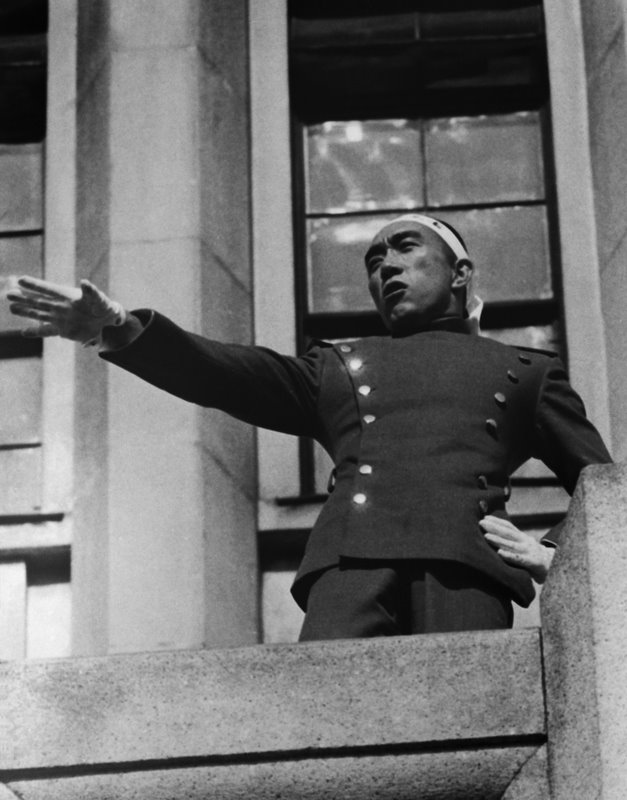
Mishima prepared his death with brilliant accuracy at least a year. November, 25, 1970, at 11 pm. In the afternoon, with members of his trusted Tatenokai; Morita, Chibi Koga, Ogawa, Furu Koga went to Ichigaya Camp, the Eastern Command Center for Self Defense Force in Tokyo, barricaded the office and arrested the commander. With prepared declamation and also fluttering banners, Mishima stepped outside balcony to the soldiers that gathered below. His speech was expected to inspire a coup for the emperor to restore his position to the way should be.
Mishima failed, he was just made the soldiers disrupted and reviled instead. He finished his speech and went back to the commander's office to do seppuku (harakiri). The kaishakunin is Masakatsu Morita, (who was rumored became the lover of Mishima) but she did not perform the task correctly, then he asked Horoyashu Koga to replace her. Morita did seppuku, Koga cut his neck.
John Nathan as the writer of Mishima’s friend biography said, the plan of coup was only a mask to cover the ritual of suicide which had been Mishima wanted for long time.
***
Mishima; destiny for him was execution of the words, recites to create divine reality incarnates the being on creation of motion that does not be servant to the history, and does not the stooge of sissy philosopher whose own the breaths of wishy-washy. The verb does not simply self reflection of the beauty of universe, the beauty of color spreads the fragrant of understanding over a feeling of fortune teller that could suggest torso of realization.
The word does not freeze in the library also settles in the shabby brain of researchers, but bear the step of courage which fated to sharpen swords, kris draw out from its place and its prestige plants deeply to the glint of eyes that fully with doubt, only the conviction or crazy that does not ask the answer.
Actions to being a word alive are not substance of quotation that is stop in a long discussion, but to fill the empty spaces without residents except have steel mental. Pram (Pramoedya Ananta Toer) had ever said: "if you fear do not be the writer (author)" and Mishima does not only a pioneer, but the destroyer of weak souls as the butcher of corrupt character whom cradled by the shallow power. Only because of the blood, after the sweat and tears of sighs perfect the words to be more meaning to transform real history.
The first lesson of strong willing is seriously creates, grabs spaces time to hit in passing, reveries is rooted out by the fingers moving that must swiftly pronounce the interpretation of life for the sake of assumed to be reality.
No dictionary of successes in the body of lazy, all focuses to a destination point. Ibn Khaldun said: "The focus is the best burning." Mishima moved all his strength for the bright future, no description in the top of his head like a hawk umpteenth flash hungry snatch its prey, the time must be token by force before stolen by the power of forgot, keep the feet set beliefs like snow covered the universe, acceleration chasing each other with the set of the sun melts.
Mishima burn fat and worked out a sense to feel his ancestors, here incarnation of the soul has meaning of the action to stripe the palm of destiny until the fate of clarity is steep, like the wind drove the flames engulfed dry leaves wage the allied air to devour the hearts to manifest, and the rain does not necessary to be waited by once suppleness of the spirit and then suddenly flood the trust. Prosperity of high desire is undeniable by apparent idea without real philosophical layer, the essence of view stared and embed into the heart of understanding, so that once they afraid and anxious then to be weak of their work’s mentality and exhausted.
Once to be a servant even though pretended to grind principle, though not subtle, double toil later, not able yet to cover up the feeling of awkward. So, throw away the nature of begging with the expression face of blackmail or even miserable, strength your face as spooky as the sun burns the forest of beauty, suck the ocean of scholarly of recluse, then step out of the cave of understanding that is sheltering for this long time.
Scum with the water of loneliness suffering and silence pain, tear machete of did not care, this is efficacious herbal concoction that must be chewed in order to proliferate to be ear mushroom. Although the ear didn’t hear, instead the fragrance of the sacrifice, hold the hand of hammer’s eyes to hit the court of time to strike until upside down and thrown away in front of all audience, until the witness had no chance to clap.
Do not let your body raised too high on the earth consciousness, whether friend or enemy, because it can break your knees which has been long been petrified to be like stones. Surrender is not a choice but ignorance of the children of insularity, spread deadly poison to kill the coquettish, cut it down until it can’t smile unless flow the blood of sacrifice.
Or burn the beard of the elders, when whiskers stroked assumed the others as a boy playing on the beach, also strip the politicians in front of honesty, do not give a chance to dress up of flirting policy, youthful fame never wither, for the time wicked breath, extinguished in the middle of the way.
Field of chances does not mean the opportunity, could be an observation of the possibility, which is the suspicion that should be confronted. Vigilance of the children of reasoning courage processes the heart to determine the magnet of intercourse of feeling and the coital action of the soul of words, lived in the same boat was sunk raving drunkenness. Fool if follow the time of experiment without carry any conviction and if thought as uncontrollably like a madman in the middle of excessive bragging.
Awareness to interpret reality breathes the life as healthy as the past states straightly up introspective. Luck comes from exploration of too much token over by force, but keep attending the sun of certainty, only clouds of doubt of empty night doesn’t result contemplation become preys.
Then grabs your age before it swallowed by the changes, it will drive rotation of the earth on its axis. The month follows its pure destiny carried on by the second triggers the explosion of desire to summarize vocabulary transformed into intuition spread into any head. The light goes in to the spaces and time to understand smile of real kissing of demolished loving and the essence of grow to scatter the seeds of faith.
The motion of obligations does not stop on the racks of reading satisfied the conscience, but an abundance of pure honey triumph after chewing, read each other to perform wanderer on stage no matter beam of light. Because of the sacred signs drag instincts to be washed away to the vortex of confidence.
Langganan:
Postingan (Atom)